A tank water heater stores hot water in an insulated tank and keeps it warm. A tankless unit heats water as it flows through a heat exchanger, so it has no stored supply. Each has strengths, and the choice depends on household size, fuel, venting and budget.
This guide compares them. If your current tank has already failed, see water heater replacement for emergency help. For planning ahead, see water heater installation.
How each type works
A tank heater holds a set volume, often forty to fifty gallons for a family, and reheats as you use it. It loses some heat while idle, which is called standby loss. If a big household uses the tank down, you wait for recovery.
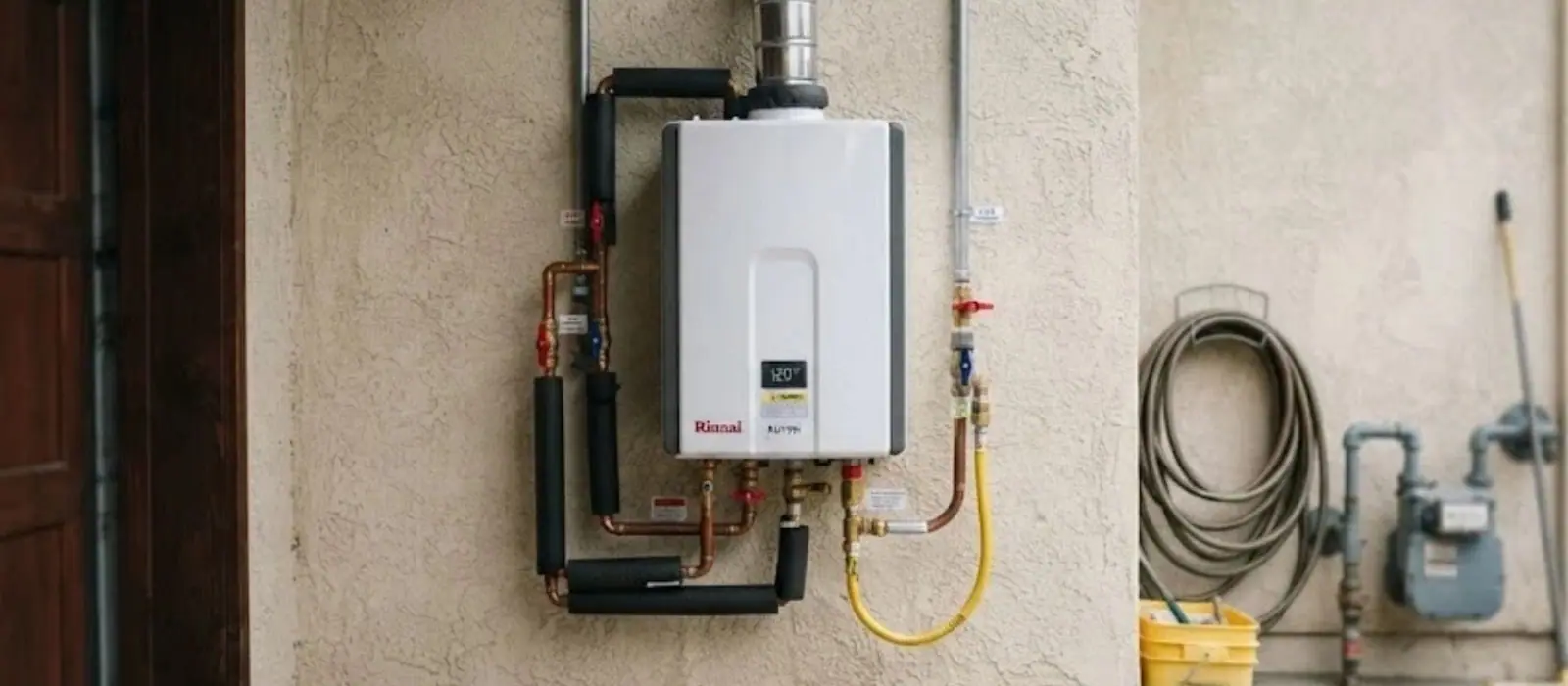
A tankless heater fires only when you open a hot tap. It can deliver hot water without limit, but its flow rate is capped. Running two showers and the dishwasher together can exceed the unit capacity.
Fuel, venting and space
Gas tankless units need larger gas lines and stainless venting, and sometimes a dedicated condensate drain. Electric tankless units draw a lot of power and may require a panel upgrade. A tank heater is simpler to install in most homes.
Tankless units are compact and mount on a wall, which frees floor space. Tank heaters need space for the tank and a pan, and in earthquake country they need bracing.
- Household size and peak hot water demand.
- Gas line size and venting path for tankless.
- Electrical capacity for electric units.
- Space available in the garage or closet.
- Local water quality and descaling needs.
- Upfront cost versus long-term operating cost.
Side by side
The table is general. A plumber can look at your gas line, venting and demand and tell you which one fits.
| Factor | Tank | Tankless |
|---|---|---|
| Upfront cost | Lower | Higher. |
| Hot water supply | Limited by tank size | Continuous, flow-limited. |
| Standby heat loss | Yes | No. |
| Space | Floor space needed | Wall mount. |
| Maintenance | Flush yearly | Descale yearly. |
| Typical life | Around a decade | Longer with care. |
When replacement makes sense
If your tank is more than a decade old, rusting or leaking, replacing it is usually wiser than repairing it. A leak from the tank body cannot be fixed. Plan ahead if you can, because choosing under pressure at six in the morning limits your options.
If you are considering tankless, ask about the extra work: a larger gas line, new venting and sometimes an expansion or scale-control accessory. The tankless water heater page covers those details.
Operating costs and efficiency
Tankless heaters avoid standby loss, so they often use less energy for households that use modest amounts of hot water. A household that uses a great deal may see less advantage. Look at the efficiency rating on the label and compare it with the tank option.
Gas and electric prices change, so the payback depends on the fuel you use and the way you use hot water. A plumber can walk through your own numbers.
Heat pump and hybrid options
A heat pump water heater moves heat from the air into the tank and uses much less electricity than a standard electric unit. It needs space and airflow, and it cools the room around it.
These units suit a garage or utility room with enough room. If you are interested, ask about the clearance, the condensate drain and the noise level.
Sizing a tank for your household
Tank size follows household size and habits. A couple may be comfortable with a smaller tank, while a family with teenagers may need a larger one. The first hour rating on the label tells you how much hot water the heater delivers in a busy hour.
If you often run out of hot water, the tank may be too small or the heater may be failing. A plumber can tell the difference by testing the temperature and checking the elements or burner.
Questions to answer before you decide
Decide how long you plan to stay in the home. A longer stay favors a tankless unit, whose higher cost spreads over more years. A shorter stay favors a standard tank.
Consider noise, space and the number of simultaneous uses. List the largest hot water demand you expect, such as two showers at once, and ask the plumber whether a given unit can meet it.
Standards behind each type
Gas storage heaters are built to ANSI Z21.10.1 and gas tankless units to ANSI Z21.10.3. Electric storage heaters are listed to UL 174. Compare the energy label and manufacturer guidelines before you buy.
Paso Robles note: cold garages and bracing
Paso Robles has dozens of freezing nights a year, so a heater in an unheated garage works harder in winter. Insulating the pipes and keeping the area around the unit clear helps either type. Whichever type you choose, a tank unit in earthquake country should be strapped to the wall studs.
Ask the City of Paso Robles building division or the county, depending on where your address falls, what permit and inspection a new heater needs. Do not rely on a generic rule from the internet.
Getting a recommendation
We install both types in Paso Robles, Templeton and Atascadero. Call (805) 249-7135, describe your household and your current setup, and a plumber will advise on the right unit.
Questions people ask
It depends. Tankless offers continuous hot water and a smaller footprint, while a tank costs less to install.
Yes. They need descaling on a schedule, and the right interval depends on your water.
Around a decade is typical, though it depends on water quality and maintenance.
Cold garages stress either type. Insulating pipes and clearing space helps, and tank heaters should be strapped.
Not sure what you are looking at? Dispatch will talk it through at any hour. Call (805) 249-7135