
Not every leak shows up as a puddle. Water can run for weeks inside a wall, under a slab or in a buried line before the first stain appears. The clues are subtle: a bill that rises without more use, a meter that moves when nothing is on or a warm spot on the floor.
This guide walks you through a simple meter test and what to do with the result. If you already see water spraying or pooling, shut off the main and call (805) 249-7135.
The meter test
Turn off every fixture and appliance that uses water, including the ice maker. Find the water meter, usually in a box near the street, and read it. Look for a small triangle or a dial that spins when water moves. Wait fifteen minutes without using any water and read it again.
If the dial moves or the numbers change, water is going somewhere. Then close the main shutoff at the house and check again. If the meter stops, the leak is inside the house. If it still moves, the leak is in the buried line between the meter and the house.
Clues inside the house
Walk through and look for the following. Musty smells, peeling paint, warped baseboards and soft drywall point to moisture in a wall. A warm patch on a concrete floor can mean a hot water line leaking under the slab.
Listen at night. A faint hiss from a wall or the floor when the house is quiet often means a pressurized line is leaking.
- Musty smell with no visible source.
- Peeling paint, bubbling drywall or warped baseboard.
- Warm spot on a slab floor.
- Hissing sound when everything is off.
- Water bill higher than the season explains.
- Low water pressure that has gotten worse.
Clues outside the house
A soggy patch in the yard during dry weather is a classic sign of a buried line leak. Unexplained green strips of lawn, sinking pavement and wet soil along the line are others. Irrigation systems leak too, so shut off the sprinklers and run the meter test again.
Check hose bibs, sprinkler valves and the area around the meter box. A dripping outdoor faucet that no one notices can waste a lot of water.
Where the leak probably is
A toilet that runs silently is the most common cause of a slow meter movement. Add food coloring to each tank to check.
| Meter test result | Likely location | Next step |
|---|---|---|
| Stops when main is closed | Inside the house | Check fixtures, then call for leak detection. |
| Keeps moving with main closed | Buried line before the house | Water line repair. |
| Moves only when sprinklers are on | Irrigation system | Check valves and heads. |
| Moves slowly | Toilet or small fixture leak | Check toilet tanks. |
| Does not move at all | No active leak | Compare bills and usage. |
Check the appliances
Look behind and under the dishwasher, washing machine and refrigerator ice maker. Supply hoses fail at the connections, and a slow drip can sit for months. A flashlight and a dry paper towel find most of them.
Check under every sink and around the base of toilets. Press on the floor for softness. A spongy section of floor near a fixture means moisture has been there a while.
Using your bill as a clue
Compare this month with the same month last year. Water use varies with the season, so a year-over-year comparison is a better test than comparing to last month. A jump with no change in household or irrigation is a flag.
Write down the meter reading each morning for a few days before the first use. A steady daily rise at that time tells you about overnight loss.
What a locator does that you cannot
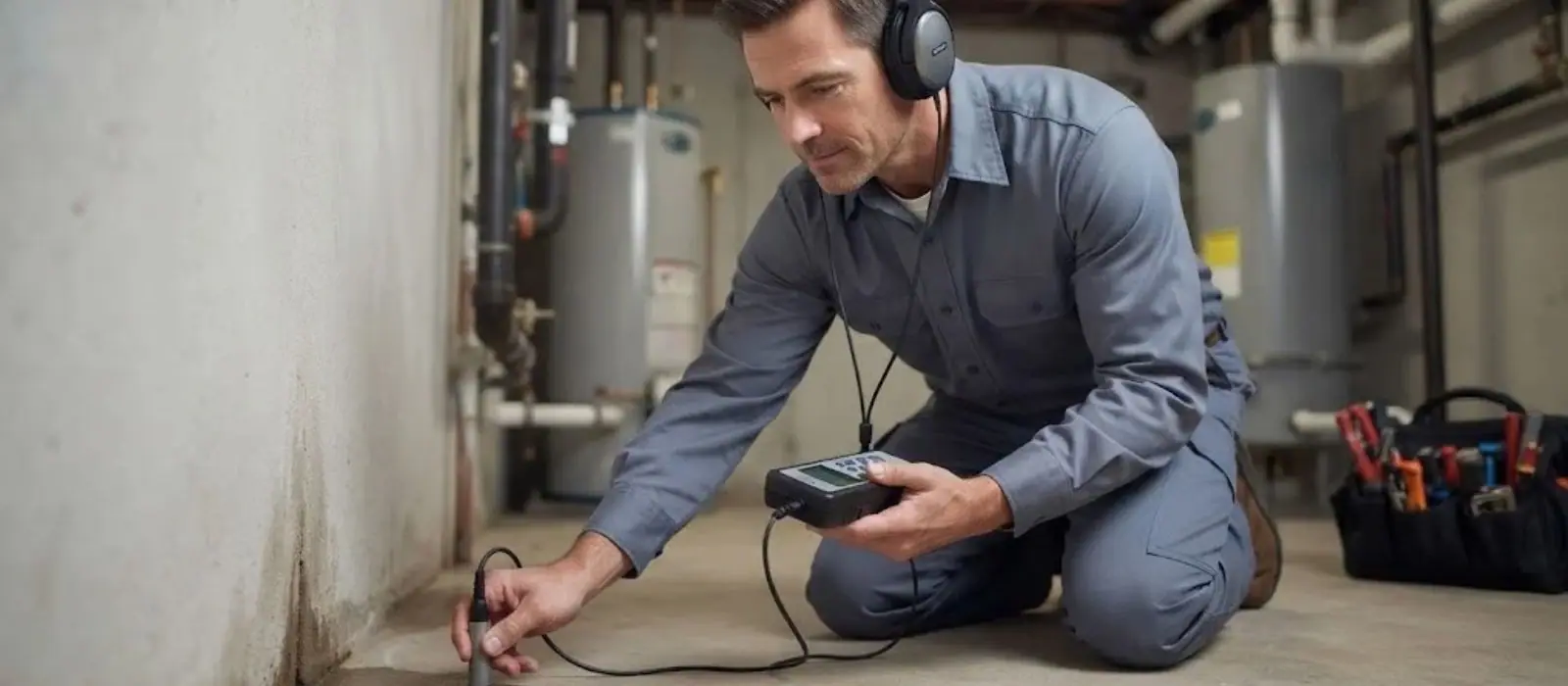
Finding a leak behind a wall without opening it takes equipment. Acoustic microphones pick up the sound of water escaping from a pressurized pipe. Thermal cameras show temperature differences from a hot water leak. Pressure tests isolate which section of pipe is losing water.
The result is a mark on the floor or wall where the opening should be. That means a small repair hole instead of a large demolition, and it keeps the repair cost down.
Guidelines for reading a meter
Your water supplier publishes guidelines for reading the meter and for reporting a leak, and the meter itself is the standard measure of use. The California Plumbing Code, Title 24 Part 5 of the California Code of Regulations and based on the Uniform Plumbing Code (UPC), governs plumbing work in the state. A professional pressure test follows its test procedures.
Paso Robles note: use EyeOnWater
Paso Robles customers can pair the meter test with EyeOnWater, the City hourly usage tool. Sign-up asks for the water account number and ZIP 93446, and a graph that never falls to zero overnight backs up what the meter showed you.
Use the tool to confirm the meter test and to see whether the leak started on a particular day. If the account is in Templeton or Atascadero, ask your water provider whether a similar tool exists.
When to call a locator
If the meter test confirms a leak and you cannot find it, leak detection uses acoustic listening, thermal imaging and pressure testing to find the spot without tearing out walls. For a slab, see slab leak repair. For a buried line, see water line repair.
We serve Paso Robles, Templeton and Atascadero.
Questions people ask
Turn off all water, record the meter, wait fifteen minutes and read it again. Movement means a leak.
Yes. Even a small constant leak adds up over a billing period.
A running toilet is the most common. Dye in the tank reveals it.
The City offers EyeOnWater, a free tool that shows hourly use and can send optional alerts for continuous flow.
Not sure what you are looking at? Dispatch will talk it through at any hour. Call (805) 249-7135